Best Time to Visit Kashmir in 2026 — What Travel Agencies Don't Tell You
Updated: Sep 2
Most Kashmir travel guides tell you when the flowers bloom or when the snow arrives. Very few explain what the experience actually feels like during those months.
June can mean hotel queues and crowded roads. January can mean snow, but also road closures and unpredictable travel.
Late September can mean something completely different — quieter roads, clearer light, and a valley beginning to change before the autumn crowds arrive.
The honest answer to “When should I visit Kashmir?” is simple: it depends on the kind of trip you want and what you are willing to trade off.
Every season in Kashmir offers something real. Every season also has a version that the package brochure rarely explains.
This guide breaks down Kashmir month by month — including weather, crowds, pricing, road accessibility, offbeat destinations and the kind of traveller each season actually suits.
Understanding Kashmir's Travel Seasons
Kashmir has five distinct travel windows, each with its own crowd profile, accessibility range, and pricing reality. The table below gives you the framework — the sections that follow give you the detail that actually matters.
Season | Months | Weather | Crowd Level | Price Range | Best For |
Spring | Mar–Apr | 8°C–18°C | Moderate | Mid-range | Gardens, tulips, photography |
Summer | May–Jun | 15°C–28°C | Very High | Peak pricing | Families, meadows, adventure |
Monsoon | Jul–Aug | 25°C–35°C | Moderate | Lower | Offbeat valleys, greenery, savings |
Autumn | Sep–Oct | 10°C–22°C | Low–Moderate | Mid-range | Luxury, photography, chinar season |
Winter | Dec–Feb | -5°C–8°C | Low (Gulmarg high) | Variable | Skiing, snow, honeymoon |
Kashmir in Spring (March – April)
Spring is Kashmir's most photogenic season on paper. The Tulip Garden — Asia's largest — peaks in early to mid-April.
The Mughal gardens come alive. The chinar trees put out new growth. The valley is green in a way that only emerges after months of cold.
The reality is more complicated. March is still cold, with temperatures dropping to 4–6°C at night. The Tulip Garden window is narrow — typically ten to fourteen days — and the crowds that arrive for it are significant.
Hotels in Srinagar raise prices during the tulip window. Dal Lake is busy ,popular spots are shared with large tour groups.

What Most Travelers Don't Expect During Spring
• The tulip peak window is unpredictable — it shifts by one to two weeks depending on that year's winter. Book only after checking the current bloom status.
• Mountain passes remain closed until late April or May. Gulmarg road can have residual snow in March. Pahalgam is accessible but cold.
Spring is worth visiting for the specific experience of the gardens and the post-winter freshness of the valley. It is not the right choice if you want accessibility to offbeat areas or predictable costs.
Kashmir in Summer (May – June)
May and June are Kashmir's peak domestic tourism months. Schools are out ,families travel. The Srinagar-Jammu highway is at its most congested.
Hotels that cost Rs. 2,500 per night in October charge Rs. 5,000–8,000 for the same room in June. Gondola queues at Gulmarg start before 8 AM.
None of this means summer is a bad time to visit. It means summer has a specific character: busy, warm, energetic, and expensive.
The meadows at Gulmarg are genuinely at their best in June — wildflowers, green slopes, comfortable temperatures. Pahalgam's Lidder Valley is running full ,Sonamarg's Thajiwas Glacier is accessible.

Who Should Visit Kashmir in Summer
• Families with children who have school holiday constraints — summer is the practical window and the infrastructure supports family travel well.
• First-time visitors who want the full classic circuit (Srinagar, Gulmarg, Pahalgam) with reliable weather and no cold-weather complications.
• Travelers who have flexibility on cost and want everything open and accessible without logistical complications.
Who Should Avoid Peak Summer
• Luxury travelers — the properties that offer the best experience in Kashmir are at their most crowded and least intimate in July.
• Travelers on a fixed budget — the same trip costs thirty to forty percent more in June than in September or October.
• Anyone planning offbeat routes — the offbeat valleys are accessible in summer, but so are crowds on the main highway, making transfers slower and more exhausting.
Kashmir in Monsoon (July – August)
Kashmir sits at the northern edge of the Indian monsoon's reach. It does not receive the heavy, continuous rainfall of coastal India.
What it does receive is intermittent rain — sometimes for two or three days consecutively, sometimes just an evening shower — and a humidity that keeps the valley intensely green through August.
This is also when the offbeat valleys are at their most alive. The Bangus Valley pastures in Kupwara peak in July. The river levels in Warwan are high and loud.
The meadows above Daksum in Breng Valley are full of Bakarwal families with their flocks. The version of Kashmir that exists in July and August — away from the main circuit — is the one that very few travelers see.

The Hidden Advantages of Monsoon Travel
• Hotel rates in Srinagar drop by twenty to thirty percent from their June peak.
• The offbeat valleys — Gurez, Warwan, Marwah, Bangus — are fully accessible and significantly less crowded.
• The quality of light for photography in the valley after rain is different from any other season.
• Kokernag's spring and Verinag's Mughal tank look their best when the surrounding garden is in full growth.
Kashmir in Autumn (September – October)
"September is the month nobody tells you about. The crowds leave. The light changes. The valley becomes itself again."
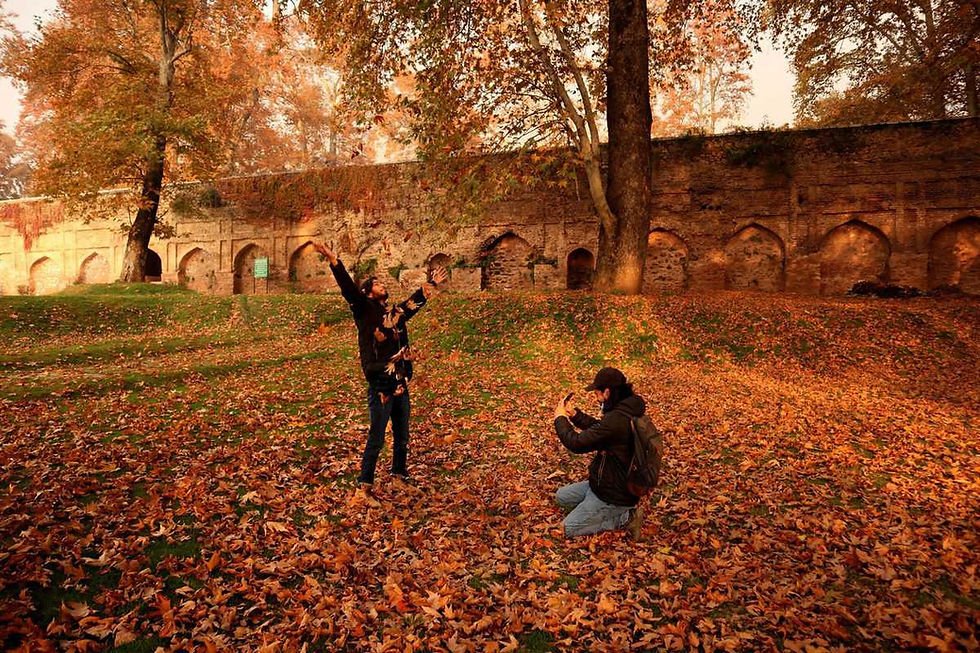
Autumn is the season that experienced Kashmir travelers return to. September sits between the monsoon and the first cold — temperatures are in the 12–22°C range, skies clear after the rain, and the chinar trees begin their shift toward red and gold. By mid-October the transformation is complete.
The Mughal gardens under full chinar color are a different place from what they are in any other season.
Hotel rates come down from their summer peaks. Traffic on the Srinagar-Pahalgam and Srinagar-Gulmarg roads is manageable.
The houseboat experience on Dal Lake in autumn cooler air, still water in the morning, the mountains behind Zabarwan beginning to catch early snow — is the version that most closely matches the images people carry in their heads when they plan a Kashmir trip.
Why September Specifically Outperforms Its Reputation
• The valley is post-monsoon green but without the rainfall risk that July carries.
• Passes to offbeat areas — Margan Top into Warwan, the Gurez approach via Razdan — remain fully open.
• The Marwah Valley rajma harvest begins in September. Arriving during harvest means access to a version of the valley that exists for three weeks a year.
• Photography light in September is cleaner than any summer month — less haze, longer golden hours.
• Kishtwar National Park is in its best window from October onward, with ibex movement and the possibility of snow leopard sightings at higher elevations.
September vs October in Kashmir
September gives you access. October gives you color. September is warm enough for evenings outside without heavy layers.
October requires a jacket after 5 PM and full winter gear by late October at altitude.
If forced to choose one: September for offbeat routes and valley experience; October for Srinagar, the gardens, and chinar season photography.
Kashmir in Winter (December – February)
The first thing to know about winter Kashmir is that the experience is highly location-dependent. Srinagar in winter is cold and quiet — temperatures drop to minus three or four at night, the city operates at half its summer pace, and the Dal Lake sometimes freezes at the edges.
It is beautiful in a specific, subdued way. It is not the right destination for travelers who need warmth and activity.
Gulmarg in winter is an entirely different product. India's only functioning ski resort operates on the Gondola lift system. January and February bring reliable snowfall at altitude.
The Khyber resort inside the meadow bowl is one of the finest winter mountain hotels in India.
For skiers, snowboarders, or travelers who want a genuine snow experience with functioning luxury infrastructure, Gulmarg from late December to late February is the answer.

What Winter Packages Rarely Explain
• The Jammu-Srinagar highway closes periodically due to snow or landslides. Flying into Srinagar is more reliable in December–January than driving. Factor this into your planning.
• The Srinagar-Gulmarg road is generally cleared, but can be closed for twelve to twenty-four hours after heavy snowfall. Itineraries that stack Gulmarg and then Pahalgam back-to-back in winter are optimistic.
• Pahalgam in winter is cold and largely closed. Most hotels operate at reduced capacity. Unless you specifically want winter Pahalgam, it is not the right stop on a December itinerary.
• Heating in lower-category hotels uses Bukhari stoves. This is traditional and effective but not thermostat-controlled. Confirm your hotel's heating before booking.
For honeymoon travel specifically, winter Kashmir — particularly a houseboat on Nigeen Lake in December or a room at the Khyber in Gulmarg in January — delivers an intimacy and quietness that the summer circuit cannot.
The trade-off is logistic ,the reward is a Kashmir that almost no one in the tourist masses sees.
Planning your Kashmir trip in 2026?
Share your travel dates and what kind of experience you are looking for.
We will recommend the right season, the right hotels, and the right itinerary —
based on what you actually want, not what is easiest to sell.
WhatsApp: wa.me/916006464123 | +91 600 6464 123
The Truth About Peak Season in Kashmir
Every travel company sells Kashmir's peak season. Very few are honest about what it costs you beyond money.
The Srinagar-Pahalgam road in June can add forty-five minutes to a journey that takes ninety minutes in October.
The Gondola at Gulmarg in June has queues that start before the cable car opens.
Hotels that book out three months in advance in peak summer are available two weeks out in September at lower rates.
The rushed five-destination-in-five-day itinerary — Dal Lake, Mughal Garden, Gulmarg Gondola, Betaab Valley, Sonamarg in sequence — exists because operators need to justify a high package price with a long activity list, not because it delivers the best Kashmir experience.
None of this is unique to Kashmir. But Kashmir's geography makes crowding more tangible than in flatland destinations. The roads are mountain roads. The passes have single-lane sections.
The valley floor concentrates everyone into the same few kilometres of highway. Peak season does not just add people — it changes the pace and texture of the experience.
A well-designed Kashmir trip in a shoulder month — late April, September, October — gives you more access per day, lower costs per night, and a version of the valley that a six-day July package simply cannot deliver.
Best Time to Visit Kashmir for Different Travelers
Traveler Type | Best Season | Recommended Months | Avoid |
Honeymoon Couples | Autumn or Winter | September, December–January | May–June (crowded) |
Families | Late Spring / Early Summer | May–June | December–February (cold, access issues) |
Luxury Travelers | Autumn | September–October | July–August (overpriced, crowded) |
Snow Lovers | Peak Winter | January–February (Gulmarg) | March onward (snow recedes) |
Offbeat Explorers | Summer / Early Autumn | June–September | October onward (passes close) |
Budget Travelers | Monsoon or Autumn | July–August, October | June and December (peak pricing) |
Photographers | Autumn | October (chinar peak) | July–August (haze, crowds) |
Best Time to Visit Offbeat Kashmir
The offbeat valleys that make Kashmir genuinely different from other Himalayan destinations — Gurez, Warwan, Marwah, Bangus — have narrow accessibility windows.
Getting the timing wrong does not just affect the experience. It can mean the route is not accessible at all.
Gurez Valley
Accessible from mid-May through October via Razdan Pass. The road opens progressively — typically mid-May — and closes by late October depending on snowfall.
The peak Gurez experience is June through September: the Kishanganga is running, the Dard villages are active, and the drive over Razdan gives you a view of the Habba Khatoon peak that is among the most dramatic in the state.
Warwan Valley and Margan Top
The approach to Warwan over Margan Top (3,696 meters) is typically accessible from June through September. The window can extend into early October in a good year.
The Choharnag lakes at the Margan plateau are best visited in this same window. Going in late May risks the pass still being under snow — always verify before departure.
Marwah Valley
June till October are the premium window. The rajma harvest is underway. The 57 peaks that rim the bowl valley are partly dusted with early snow at the high elevations.
The light in September in Marwah — a closed valley with no through traffic — is unlike anything accessible on the standard Kashmir circuit.
Bangus Valley
Bangus in Kupwara district is accessible from June through October. The meadow peaks in July when the Bakarwal families are in residence with their flocks and the pasture is at full growth.
The drive from Srinagar via Mawar or Langate takes two to three hours. It is a day trip that works, but two nights in Bangus gives you the morning light on the meadow that a day visit cannot.
Key rule for offbeat Kashmir: all major valley routes — Gurez, Warwan, Marwah, Bangus —
require departure from Srinagar no later than early October.
By November, high passes close and accommodation in these valleys is non-operational.
We maintain current road and accommodation status for all routes. Ask us before you plan.
Common Mistakes Travelers Make While Planning Kashmir Trips
Choosing Peak Dates for the Wrong Reasons
May and June are popular because schools are out, not because they are the best months to experience Kashmir.
If you have flexibility, even shifting to late June or early September changes the trip significantly.
Expecting Snow at the Wrong Destinations in the Wrong Months
Snow in Srinagar city is rare and brief — typically a few days in January. Snow in Pahalgam town is light and inconsistent.
Gulmarg at altitude is the reliable snow destination and functions that way from December to February.
Travelers who book a Srinagar-Pahalgam winter itinerary expecting a snow experience are frequently disappointed.
Compressing Too Many Destinations into Too Few Days
A five-day itinerary that includes Srinagar, Gulmarg, Pahalgam, Sonamarg, and Doodhpathri is technically possible and practically exhausting.
Each of these places rewards time. Gulmarg deserves two nights.
Pahalgam needs a day for Aru and a separate day for Betaab Valley. Compressing them into a five-stop, five-day sequence means you see everything and experience nothing.
Underestimating Mountain Road Travel Time
Google Maps distances in Kashmir do not translate to Google Maps travel times. The Srinagar-Gulmarg road is 51 kilometers. It takes ninety minutes minimum and longer in traffic.
Margan Top to Inshan in Warwan is a half-day journey. Building itineraries on urban travel-time assumptions produces days that either run late or cut short.
Not Asking About Specific Hotels Before Booking
This applies year-round but matters most in peak season. "3-star hotel in Srinagar" in a June package is a category, not a property.
The specific property, its location, and its current condition matter more than the category. See our 3-Star Hotels in Kashmir guide for the full picture on this.
Final Verdict — So When Should You Actually Visit Kashmir?
There is no single best month. There is the right month for the experience you are after.
If you want the full green valley, open passes, and offbeat accessibility: June to September. If you want the chinar season, lower prices, and an intimate version of the classic circuit: September and October.
If you want guaranteed snow and are prepared for the logistics: January and February in Gulmarg. If you are planning a honeymoon and want to avoid crowds: September or December.
The travelers who have the best Kashmir experiences are almost never the ones who visited during peak July. They are the ones who either went earlier, went later, or went somewhere entirely different from the standard circuit.
Kashmir rewards the traveler who asks more specific questions than "when is the best time." The question that actually helps is: what do I want this trip to feel like? Answer that first. The right month follows from the answer.
Plan Your 2026 Kashmir Trip With Ground-Level Knowledge
We have covered Kashmir across every season — tulip spring, monsoon valleys, chinar autumn, and winter Gulmarg. Every recommendation we make on timing, hotels, and routing comes from having been there, not from a brochure.
Tell us your dates, your group, and what kind of experience you are looking for. We will tell you honestly whether your chosen timing is the right fit — and if not, what would serve you better.
Call / WhatsApp: +91 600 6464 123
Email: support@tribesmen.org
Tribesmen Travels — J&K Tourism Registered
Chandpora, Harwan, Srinagar, Kashmir 191123
Frequently Asked Questions — Best Time to Visit Kashmir
What is the absolute best month to visit Kashmir?
September is the month we recommend most consistently across traveler types — mild weather, lower crowds, open offbeat routes, and autumn color beginning on the chinar trees.
October is the best month specifically for chinar season photography and Srinagar-focused trips. June is the best month for the full green meadow experience at Gulmarg and Pahalgam. The right answer depends on what you are going for.
When does Kashmir receive snowfall?
Significant snowfall in Srinagar city typically occurs in January, occasionally in late December or February. Gulmarg at altitude receives reliable snow from December through February.
Higher elevations — Margan Top, Razdan Pass, the passes above Marwah — can receive snow from October onward. Do not plan for snow in Pahalgam town or Srinagar city with any certainty outside of January.
Is Kashmir crowded in summer?
Yes, significantly. May and June see the highest domestic tourist volumes of the year. Hotels in Srinagar, Gulmarg, and Pahalgam are at capacity. The Gondola at Gulmarg has long queues.
Road traffic on main routes is heavy. If crowd levels affect your enjoyment, plan either earlier in the year (late April) or later (September–October).
When should you avoid visiting Kashmir?
There is no universally bad time — there are times that are wrong for specific trips. Peak June is not ideal for luxury or offbeat travelers. January is not ideal for families or those without cold weather preparation.
The Amarnath Yatra period (July–August) adds significant congestion on the Pahalgam route. The highway closure season (heavy winter snowfall on Jammu-Srinagar) can disrupt road-based itineraries in January. Flying into Srinagar eliminates most of the winter access risk.
Is September or October better for Kashmir?
September for experience, October for color. September gives you warm evenings, open passes, active offbeat valleys, and the valley before the tourist traffic fully departs. October gives you the chinar color peak, cooler temperatures, and a Srinagar that is quieter and more settled.
If your trip is Srinagar-focused: October. If it includes Gurez, Warwan, or Marwah: September.
What is the best time for a luxury Kashmir trip?
Autumn — specifically late September through mid-October. The premium properties (Taj Dal View, Radisson Collection, Khyber in Gulmarg) are past their summer peak demand.
You get better room availability, more attentive service at lower occupancy, and the most atmospheric version of the valley. For winter luxury specifically, Gulmarg at the Khyber in January is the best single-property luxury Kashmir experience available.
Can I visit offbeat Kashmir in winter?
The major offbeat valleys — Gurez, Warwan, Marwah, Bangus — are not accessible in winter. Passes close by October–November and do not reopen until May or June. Daksum in South Kashmir remains accessible but is cold and quiet.
If you want offbeat Kashmir combined with winter travel, plan for the November window before full closure, or plan an autumn trip and let the season do the work.

Comments