Keran Valley Travel Guide 2026: Permit, Route, Best Time to Visit & Border Experience
Updated: Sep 2
There is a moment, somewhere between the permit office at Kralpora and the final few kilometres of road into Keran, when it begins to feel like you are travelling towards the edge of something. Not in a dramatic sense, but quite literally.
The road narrows, the mountains close in, and the river grows louder. Then you arrive and realise that the edge is exactly what Keran is.
Keran is not a destination most travellers in Kashmir accidentally discover. It sits in Kupwara district, tucked deep into the northern reaches of the valley, and getting there requires a deliberate decision.
This Keran Valley Kashmir Travel Guide covers everything you need to know before visiting one of Kashmir's most unique border destinations, including permit requirements, route details, accommodation options, connectivity and the best time to visit.
The journey takes most of a day, a permit is mandatory, and the settlement itself is small, quiet and surprisingly modest. By conventional sightseeing standards, there is not much to do.
Yet people who visit often return with stories that are difficult to explain.
Not because of a famous viewpoint or a long list of attractions, but because of the unusual experience of standing on one bank of a river and watching ordinary life unfold on the other side, in another country. That, more than anything else, is what Keran is about. But we will come to that shortly.
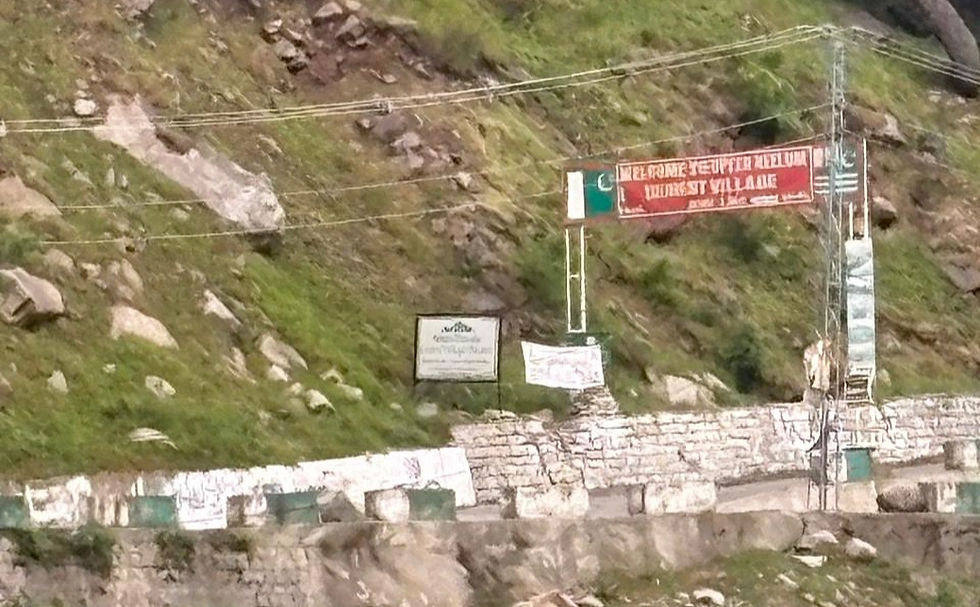
Quick Overview
Distance from Srinagar: 130–140 km
Travel Time: 4–5 hours
Permit: Mandatory
Best Season: June–October
Internet: Very Limited
Ideal Duration: 1 Night
Altitude: (5,000 ASL)
Looking to Explore Offbeat Kashmir?
Discover lesser-known valleys, villages and landscapes beyond the usual tourist circuit, with private transfers, carefully planned stays and personalised experiences.
Getting to Keran: The Route from Srinagar
Route: Srinagar → Handwara → Kupwara → Kralpora → Pharkian Top → Keran
Distance: Approximately 130–140 km from Srinagar
Travel time: Allow 4 to 5 hours, depending on road conditions and how long you spend at checkpoints
The road out of Srinagar towards Handwara and Kupwara is straightforward and reasonably well-maintained for the most part.
Once you cross into the Kupwara district, the character of the journey changes — the towns thin out, the landscape opens up and the road begins climbing. Pharkian Top is the high point of the drive and on a clear day the views from here are worth stopping for.
The descent into Keran after Pharkian Top brings you down into the gorge itself.
Road conditions on this route are generally good, though mountain roads always carry the caveat that conditions after heavy rain can change quickly.
Check before you travel, particularly if you are going in October or later in the season.
Security checkpoints: You will pass through multiple checkpoints on this route. This is standard in the Kupwara district and not something to be anxious about, but factor it into your travel time.
Having your documents — original Aadhaar card and permit — immediately accessible rather than buried in your bag will make these stops quicker.
Officers at checkpoints are generally courteous; just be patient and straightforward. Do not photograph checkpoints or military installations at any point along the route.
The Permit: What You Need and How to Get It
You cannot visit Keran without a permit. This is not negotiable and there is no way around it — the checkpoint system is thorough enough that attempting to visit without proper documentation would simply result in being turned back.
Where to get it: Kralpora Police Station. This is your stop, and you will want to factor it into your travel day. Kralpora comes before Keran on the route, so you will pass through it naturally.
What you need: Your Aadhaar card is mandatory. You will need photocopies of it as well, along with the permit application form.
Practical tip: There are small shops near the Kralpora Police Station that sell photocopies and stock the required forms. This is a well-established part of the permit process for visitors, and the shopkeepers know exactly what you need.
If you have not already made photocopies before leaving Srinagar or Kupwara, you can sort it out here. It is worth making a few extra copies of everything — different checkpoints may take a copy each.
The permit process itself is not particularly complicated, but it does take time. Police stations operate on their own schedule. Be polite, be patient, and do not show up expecting to be in and out in ten minutes.
Some visitors report processing times of thirty minutes or less than that depending on how busy the station is and whether there are any administrative complications that day.
If you are travelling in a group, bring documentation for everyone. Each individual needs their own Aadhaar card.
Foreign nationals: Keran, like most areas close to the Line of Control in Jammu & Kashmir, is not open to foreign nationals without special permissions that are separate from and more involved than the standard police permit. If you hold a foreign passport, verify your eligibility well in advance through official channels.

What Keran Actually Is — And Is Not
This matters, because a number of people arrive at Keran with expectations shaped by descriptions of Kashmir's more expansive destinations, and Keran does not match those expectations in terms of scale or landscape variety.
Keran is not a broad, open valley in the way that Gurez or Marwah is. It is more accurately described as a narrow river gorge — the Kishanganga River (called the Neelum River on the Pakistani side) has cut a steep channel through the terrain, and the settlement of Keran is compact, perched along the riverbank.
There are mountains on either side, the river runs fast and loud, and the place has an enclosed, intimate quality rather than the sweeping panoramic quality of a high mountain valley.
The settlement itself is small. Do not expect a town , there are few shops of modest size, some accommodation, a few tea stalls and restaurants, and not a great deal else in terms of infrastructure for tourists.
This is a genuine frontier village, not a tourist hub that has grown up around visitor demand.
If you come expecting Keran to be similar in experience to Gurez or Warwan, you will probably feel the visit is shorter and simpler than you anticipated.
If you come understanding what it actually is — a quiet, historically charged river settlement at the edge of two countries — you are likely to find it quietly compelling.

The Real Reason People Go to Keran
There is one thing that makes Keran genuinely unlike anywhere else in India that most people can easily reach, and it is this: you can stand on the riverbank and see Pakistan.
Not in the abstract, geopolitical sense of being in a border region. In the literal, immediate sense of looking across a river — a river you could probably throw a stone across at certain points — and watching people go about their day.
Houses, hotels, roads, vehicles, occasionally people walking or working. The Pakistani village of Sharda and other settlements on the Neelum Valley side are visible at remarkably close range.
There is no extended buffer zone, no long stretch of no-man's land, no barbed wire running through the middle of the view. The separation is the river itself, and the river is not wide.
People on both sides sometimes wave to each other.
Carry binoculars this is one of those recommendations that sounds optional but really is not, if you want to get the most out of being in Keran. With a decent pair of binoculars, the detail visible on the Pakistani side — buildings, vehicles, individuals going about daily life — is striking in a way that it simply is not with the naked eye.

How Long to Stay
One night and one full day is enough for most visitors, and it is probably the right amount of time.
Keran does not have a list of sights to work through.
There is no monastery, no famous lake, no trek to a high pass that most people do in a day. The experience is more passive and more contemplative — you are there to be in the place, to walk along the river, to sit and look, to absorb the particular atmosphere of a small settlement that happens to sit against one of the most significant and complicated borders in the world.
Staying one night means you can arrive in the afternoon, spend the remaining daylight hours at the river and in the village, have an evening, and then spend the following morning at a pace that is not rushed before heading back. That feels like the right rhythm for this place.
Could you do it as a day trip from Kupwara or even Srinagar? Technically, but the driving time is significant and you would arrive feeling pressed. One night is worth it.
Best Time to Visit Keran
June is the start of the viable season. The weather is pleasant, the river is running high and fast with snowmelt (impressive to see, though you will not be wading in it), and the vegetation along the gorge is intensely green. June is a good time if you want Keran at its most lush.
July and August are the peak summer months. Temperatures at this altitude are comfortable — warm during the day, noticeably cooler in the evenings.
These are the most popular months for visitors to the region generally, and while Keran is never busy in any conventional sense, you are more likely to encounter other travellers at this time.
September is, by many accounts, the most satisfying month to visit. The summer crowds have thinned, the skies are cleaner and clearer, visibility across the river is excellent, and the mountains surrounding the gorge begin to take on a sharpness in the autumn light that is particularly good for photography.
October brings the most dramatic visual conditions — the deciduous vegetation along the river corridor turns, the light is golden and low, the air is cold and still.
October is one of the best months for photography at Keran and elsewhere in this part of Kashmir. It is also the last reliable month of the season.
Accommodation
Options in Keran are limited, and this is not something likely to change in the near term. There are guesthouses in the village, and they are adequate for a night, but do not arrive without having confirmed a booking in advance.
This is not a place where you can show up and assume you will find somewhere comfortable to stay — the number of rooms available for visitors is small, and during the summer months they can fill up.
If you are travelling independently, make enquiries about accommodation before you leave Srinagar. Your driver, if you have hired a local driver for the trip, will often have contacts or know the current state of availability.
Camping, which many visitors assume is a natural alternative in a mountain setting, is in practice limited at Keran. Suitable flat ground is scarce in a river gorge, and there are security considerations in an area this close to the Line of Control.
Do not plan your trip around camping without having confirmed in advance that it is feasible and permitted.
Food and Supplies
You will not go hungry in Keran. There are restaurants and tea stalls in the village, and the food is what you would expect from a small Kashmiri mountain settlement — dal, rice, rotis, chicken, basic but filling.
Do not arrive expecting elaborate meals or menu variety, but equally do not feel that you need to pack significant food supplies for this trip.
A basic and reasonably reliable food situation exists.Carry water for the drive, and perhaps snacks for the road, but this is not a wilderness expedition that requires careful rationing.
Connectivity and Internet
Be very clear about this before you go: internet connectivity in Keran is nil . Airtel reportedly has signal at certain spots in and around the area, but this is inconsistent and cannot be counted on. Other networks may have no signal at all.
If you work remotely, have time-sensitive online obligations, or are travelling with someone who needs reliable connectivity for any reason, factor this in. For most leisure travellers, a day or two offline is fine, but it is worth knowing in advance rather than arriving and being caught out.
Mobile calls may be possible with Airtel, again depending on where you are standing. Do not rely on being reachable or being able to reach others by phone during your time in Keran.
How Keran Compares to Other Offbeat Kashmir Destinations
It is worth being direct about this, because the comparison affects who should visit Keran and who might be better served by another destination.
Gurez Valley is, in most respects, a bigger and more varied destination. It has a broader valley floor, more diverse landscape, longer trekking options, and its own compelling border-proximity element without the compressed, gorge-like intensity of Keran.
If you want a multi-day immersive experience with more to see and do, Gurez is likely the better choice. Gurez also has more accommodation options. If you have not been to either, and can only choose one, most travellers with a week or more in Kashmir would get more from Gurez.
Warwan Valley is a more serious undertaking than either Keran or Gurez — the access road is more challenging, the valley is more remote, and the landscape is on a different scale.
Warwan is for people who want to go further and deeper. It is not a casual weekend trip from Srinagar.
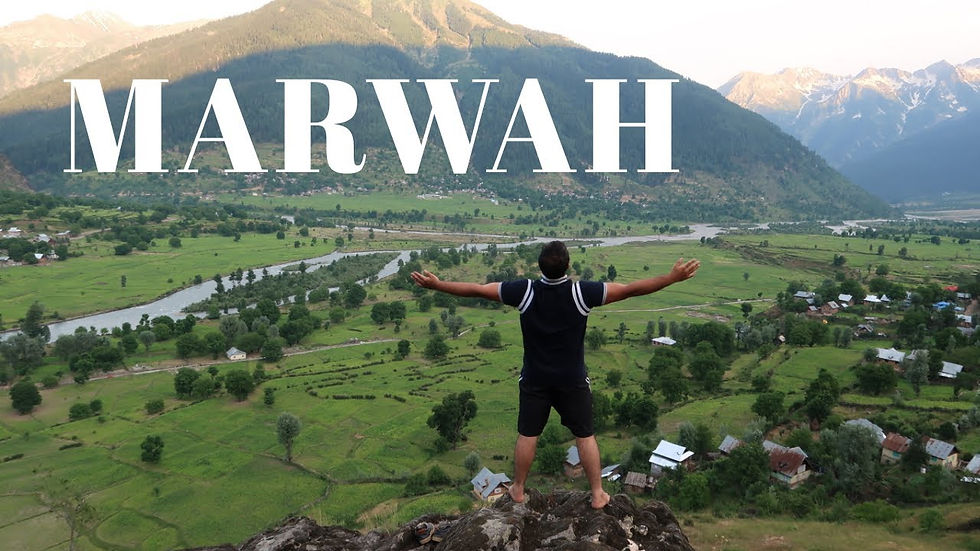
Marwah Valley is a different experience altogether. Vast, remote and surrounded by some of the highest mountains in Jammu & Kashmir, it appeals to travellers looking for wilderness and scale rather than proximity to a border.
If Keran's uniqueness lies in what is across the river, Marwah's lies in the immense landscape that surrounds you.
Keran sits in a category somewhat on its own. It is not primarily about landscape variety or trekking options or the grandeur of high mountain scenery. It is about proximity — to the river, to the border, to the particular and unusual experience of seeing another country at close quarters .
If that specific thing interests you, Keran is worth going to. If it does not particularly interest you, the limited sightseeing options and the long drive may leave you feeling the trip was not quite worth it.
Practical Summary
Documents: Original Aadhaar card plus multiple photocopies. Keep them accessible throughout the journey, not buried in luggage.
Permit: Obtained at Kralpora Police Station. Shops nearby have forms and photocopies. Allow time — do not rush this stop.
Checkpoints: Multiple, throughout the journey. Be patient. Do not photograph military installations or checkpoints.
Accommodation: Book in advance. Options are limited. Camping is not reliably feasible.
Food: Restaurants and tea stalls are available. No need to carry significant food supplies.
Connectivity: Expect to be largely offline. Airtel may work in spots. Plan accordingly.
Binoculars: Bring them they make a substantial difference to the border-viewing experience.
Best months: June through October, with September and October offering the best conditions for photography and clearest visibility.
Time needed: One night and one full day is the right amount for most visitors.
Who should go: Travellers with a genuine interest in the border experience and the human geography of the Kashmir divide, those who value quiet and unusual places over conventional sightseeing, photographers interested in the autumn light conditions of October.
Who might prefer elsewhere: Travellers looking for an active multi-day itinerary, those who need reliable internet, anyone whose main interest is panoramic mountain scenery or trekking options.
Keran is a specific kind of place. It asks something of you — a willingness to make a real journey for an experience that is not easily categorised or photographed into adequacy.
The Kishanganga runs fast and cold between two countries, and on a clear day, with binoculars, you can see the other side with a clarity that does not feel like it should be possible that is what Keran offers.
Whether that is enough is something only you can decide, but for those who go for exactly that reason, it tends to be.
See also: Gurez Valley Travel Guide | Marwah Valley Travel Guide | WarwanTravel Guide | Offbeat Places in Kashmir | Lolab valley Travel Guide | Kalaroos Caves Travel Guide
Frequently Asked Questions About Keran Valley
Where is Keran Valley located?
Keran is located in Kupwara district of Jammu & Kashmir near the Line of Control (LoC). It lies along the banks of the Kishanganga River, known as the Neelum River across the border.
How far is Keran Valley from Srinagar?
Keran is approximately 130–140 kilometres from Srinagar. The journey usually takes 4–5 hours via Handwara, Kupwara, Kralpora and Pharkian Top.
Is a permit required to visit Keran Valley?
Yes. Visitors are required to obtain permission from Kralpora Police Station before proceeding to Keran. Carrying a valid Aadhaar Card is mandatory.
How do I get a permit for Keran Valley?
Visitors need to submit the required documents at Kralpora Police Station. Photocopy and documentation facilities are easily available near the police station.
What is the best time to visit Keran Valley?
The best time to visit Keran Valley is from June to October. During these months the roads remain accessible, the weather is pleasant and the valley is at its most scenic.
Is Keran Valley worth visiting?
Yes, but for a specific reason. Keran is less about sightseeing and more about experiencing life along the border, where villages on both sides of the Kishanganga River can be seen at remarkably close range.
How many days are enough for Keran Valley?
For most travellers, one day and one night are sufficient. Keran is a compact destination with limited sightseeing opportunities compared to larger valleys like Gurez or Warwan.
Are there hotels in Keran Valley?
Accommodation facilities are available but limited. Visitors are advised to book their stay in advance, especially during the summer season.
Is camping possible in Keran Valley?
Camping options exist but are limited due to space constraints. Travellers interested in camping should make prior arrangements before visiting.
Is mobile network available in Keran?
Mobile connectivity is limited. Airtel works in certain locations, but visitors should not expect reliable internet or mobile data services throughout their stay.
What is the main attraction of Keran Valley?
The biggest attraction is the unique border-side experience. Visitors can observe daily life across the river on the Pakistani side, making Keran one of the most unusual travel experiences in Kashmir.
Is Keran Valley safe for tourists?
Yes. Keran receives visitors regularly and remains one of Kashmir's unique border destinations. Travellers should follow local regulations and carry valid identification documents.
Can Keran Valley be visited as a day trip from Srinagar?
Yes, but an overnight stay is recommended. Spending a night allows visitors to experience the atmosphere of the village and enjoy the landscape without rushing.
What makes Keran different from Gurez Valley?
Gurez is a larger valley known for dramatic landscapes, multiple villages and longer itineraries. Keran is much smaller and is primarily known for its unique location along the Line of Control.
What should I carry while visiting Keran?
Carry a valid Aadhaar Card, warm clothing depending on the season, cash, essential medicines, a power bank and binoculars for the best experience.
Can Keran be combined with other destinations?
Yes. Keran is often combined with other Kupwara district destinations such as Lolab Valley, Bangus Valley and Kalaroos Caves for a broader offbeat Kashmir experience.


Comments