Sarasnag Trek : Kashmir’s Most Remote Alpine Lake
Updated: Sep 2
It’s 4a.m. in the cold silence of Saranag — we, a group of hunters, stood poised in the dim dawn light. Just as I tightened my grip and began to pull the barrel of my gun, the lake stirred and from its depths rose a giant snake, larger than anything we had ever imagined in the mountains of Marwah.
In that moment, shock swallowed our voices, and Saranag felt like a place where legends come alive .

Quick Overview — Sarasnag Trek (Marwah Valley)
Location: Marwah Valley, Jammu & Kashmir
Altitude: ~12,000+ ft
Trek type: Day trek (6–7 hrs return)
Difficulty: Moderate to strenuous
Best time: June to October
Route: Yourdoo → Apan → Nursery → Bakarwal zone → Sarasnag
Looking to Explore Offbeat Kashmir?
Discover lesser-known valleys, villages and landscapes beyond the usual tourist circuit, with private transfers, carefully planned stays and personalised experiences.
Why Sarasnag Is Marwah Valley's Most Sacred Alpine Lake
Hidden beneath Dangerhell Peak at over 12,000 feet, Sarasnag is one of the most important alpine lakes in Marwah Valley.
For the Bakarwal community it is a place of annual prayers and deep cultural significance.
For trekkers, it offers one of the most rewarding day hikes in the region, combining alpine scenery, shepherd settlements and a landscape largely untouched by mainstream tourism.
The story Mohammed Rajab told me
Mohammed Rajab runs a shop in Bata village, near the confluence where the Rannai Nala meets the Maru Sudar river. His home sits on the banks of river creates as it braids across the Marwah floor — the same islets that make this the only bowl valley in Jammu and Kashmir.
It is a beautiful location in the most understated way: the river on both sides, the mountain walls visible in every direction, and Mohammed Rajab's shop at the centre of it all.
I had visited a few times. We talked the way you talk when you have time and no particular agenda — about the valley, about the seasons, about who had been through recently and where they were going.
He is one of those people who holds the local knowledge of a place the way old libraries hold books — not arranged for access, but all there if you know how to look.
One afternoon he mentioned Sarasnag. He said he had been there — this was the late 1980s or early 1990s, the same period when trekkers from across India and Europe still came to Marwah following the old Yourdoo–Methwan–Mundeksar routes to Kargil. He had gone with a group, sleeping near the lake.
What he saw at 4 AM
It was early morning, he said. Four o'clock. He had been sleeping very close to the water's edge — as people do at alpine lakes, where the flat ground near the shore is the most sheltered campsite. He heard a sound. He woke from the lake, something was emerging.
A large snake. Coming out of the water , he reached for his camera — because he had one, which in the 1980s in a remote Kishtwar valley was not a small thing — and he clicked the photograph before he fully understood what he was doing.
He said: I was stunned .i was shocked & i stayed still. Another man in the group was awake by then and he had also seen it. Both of them watched until it was gone.
When he told the others in the morning, several of them said they had also seen it or heard the sound. Nobody had a second photograph. Mohammed Rajab had the only one.
He has not given me the photograph yet. When I meet him again — the next time I am in Bata village, on the islets of the Maru Sudar — I will ask him again, and when he gives it to me, I will add it to this blog. That is a promise I am making publicly.
The photograph exists. Mohammed Rajab has it. It was taken at the edge of Sarasnag in the late 1980s or early 1990s. When it arrives, this blog will be updated. Until then, his account is what we have — and his account is specific, consistent and told without embellishment by a man who has no reason to invent it.

What Makes Sarasnag Unique
Unlike most alpine lakes in Kashmir, Sarasnag is known not only for its scenery but also for its cultural and spiritual significance. Located beneath Dangerhell Peak in the Marwah Valley, the lake is associated with local traditions, annual Bakarwal prayers and stories that have been passed down through generations. These layers of history and belief give Sarasnag a character that goes far beyond its natural beauty.
Sarasnag carries this forward more fully than most. Saras — the head, the source, the origin. Nag — the serpent presence. The head of all serpent lakes. The first one the one from which the others are descended.
Whether you hear this as mythology, as local ecology, as the compressed memory of actual sightings over generations, or as all three at once — it changes how you stand at the edge of this lake.
The cloudcover that almost always sits over Sarasnag is not weather. It is atmosphere, in both the literal and figurative senses.
The lake is cold and deep and dark, and it sits beneath one of the most dramatically named peaks in the Dangarhel range, and a man from Bata village has a photograph of something that came out of it before dawn. That is the context in which you approach Sarasnag. You should know it before you go.

Sarasnag in the Marwah Ecosystem
Sarasnag is not an isolated alpine lake. It forms part of a larger high-altitude ecosystem that includes Yourdoo village, Apan, the seasonal Bakarwal settlements, Dangerhell Peak and the upper grazing grounds of Marwah Valley.
The streams flowing from this mountain system eventually join the Marusudar River, sustaining communities and pastures further down the valley. Understanding Sarasnag means understanding the wider mountain landscape that surrounds it.
For trekkers, this is one of the most rewarding aspects of the route. The journey is not simply about reaching a lake. It is an opportunity to experience the interconnected world of shepherd communities, alpine meadows, wildlife habitats and high Himalayan watersheds that define Marwah Valley
Dangerhell Peak — The Mountain Above the Lake
Sarasnag sits beneath Dangerhell Peak in the Dangarhel mountain range. The peak stands at 15,598 feet. The name was not invented for tourism. It was given by the people who first approached it or attempted it, and it reflects their assessment of what they found.
In a valley that also contains Mount Nun at 23,410 feet — the highest summit in Jammu and Kashmir — Dangerhell is not the tallest peak. It is the one whose name alone stops you and makes you look up.
I have been to many mountains. I have stood at the edges of places that deserved their reputations. But Dangerhell as a peak is something else.
From the trail to Sarasnag, as you gain altitude through the Nursery and into the upper Bakarwal grazing ground, the peak begins to dominate the eastern skyline in a way that changes your relationship with the altitude you are climbing.
It is not simply big. It is present in the particular way that peaks are present when they have earned their names.
The combination — the named peak above, the sacred lake below, the cloudcover that keeps the view earned rather than given — is what makes the Sarasnag trek different from every other alpine lake walk in Marwah, and different from most alpine lake destinations in Kashmir.
Most Kashmir alpine lakes are beautiful. Sarasnag is beautiful and it has a character — a weight — that most alpine lakes do not. Dangerhell Peak, the mythology of the nag, Mohammed Rajab's photograph, the Bakarwal prayer ritual that happens once a year at the water's edge — these things accumulate. By the time you are standing there with the cloud moving across the summit above you, you are not simply at a lake. You are at the head of something.

Getting to Sarasnag — The Apan Village Route
There are two ways to reach Sarasnag from Yourdoo, the main village base in Marwah Valley. One is via Pethgam village. One is via Apan village.
I take the Apan route every time.Apan is more direct, the trail is more consistent, and the approach through the Nursery — a clearing in the pine forest at around 9,000 feet that opens with a view that most guests stop at for longer than they planned — makes the ascent feel earned in the right sequence.
The Pethgam route is longer and the terrain is less forgiving for a day return. If you want to come back to Yourdoo in the evening of the same day, which is entirely possible via Apan, pethgam makes that tighter.
This is a day trek. Not a camping trip, not a multi-day expedition. You leave Yourdoo in the morning, you reach Sarasnag, you descend, you are back in the valley by evening.
That is the standard plan. If you want to camp at the lake — and the experience of camping at Sarasnag, having heard Mohammed Rajab's story, is a different kind of night — arrange it with us separately.
Waypoint | ~Altitude | ~Time from prev. | What you find |
Yourdoo village | ~7,200 ft | Start point | Base in Marwah. All Sarasnag treks begin here. |
Apan village | ~9000 ft | 1.5 hours | The recommended approach entry. Village at the base of the main ascent. |
The Nursery | ~9,500 ft | 30 minutes hrs from Apan | A beautiful clearing in the forest. First serious views open here. Bakarwal settlements visible above. |
Bakarwal summer zone | ~10,500 ft | 45 min from Nursery | Active nomadic settlements in summer. Tea and namkeen chai available if timing is right. |
Sarasnag — the lake | ~12,000 ft+ | 1.5–2 hrs from Bakarwal zone | Alpine lake beneath Dangerhell Peak. Sacred site. Cloud-covered most days. The head of all alpine lakes. |
Start Yourdoo village — Early morning — 6 to 7 AM departure
Leave early. The logic is the same as for every high-altitude day trek in Kashmir — you want the morning light, you want to reach the upper zone before the afternoon clouds build, and you want enough time at the lake to actually be there rather than immediately turning back.
From Yourdoo, the first section to Apan village is a gentle trek of about 1 - 1.5 hours .
Apan Village entry point — 1-1.5 hours from Yourdoo
Apan is a small village on the lower slope of the Dangarhel range. The trail into the mountain starts here. From Apan, the character of the walk changes — you begin climbing properly, the path entering pine and deodar forest, the valley floor dropping away behind you.
This is the section where the altitude starts to work on the body. Go at your own pace. There is no hurry.
The Nursery ~9,000 feet — 30 minutes from Apan
The Nursery is a clearing in the forest at roughly 9,500 feet — a place where the trees thin and a flat open area emerges with the first full views outward toward the Marwah bowl below and the higher peaks above.
It is called the Nursery for reasons I have not been able to definitively trace, though the dense and carefully spaced tree regeneration in this zone suggests it may have been a deliberate planting area at some point.
Whatever the origin of the name, the place is beautiful in the particular way that alpine clearings are beautiful — the transition from enclosed forest to open sky feels like a relief every time, no matter how many times you have made this walk.
Every group I have brought here stops at the Nursery longer than they planned. That is the correct response.
Bakarwal settlements ~10,500 feet — 45 min above the Nursery
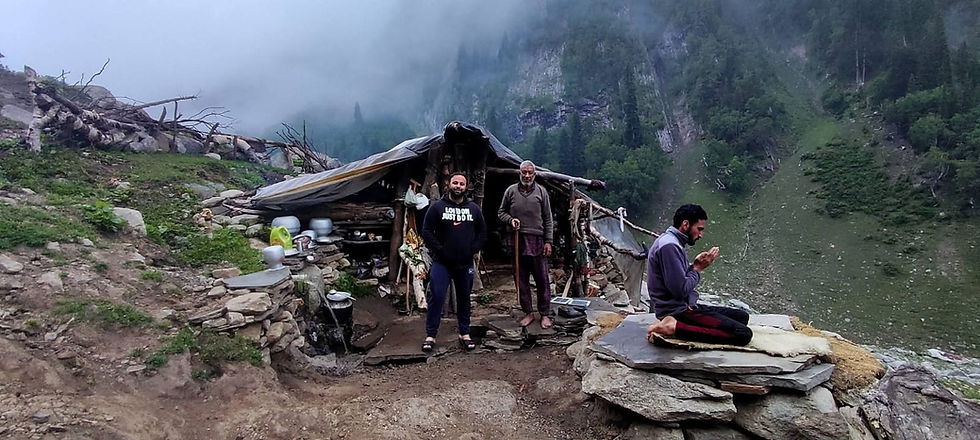
Above the Nursery, the trail enters the high grazing zone where the Bakarwal and Gujjar families set up their summer settlements. In the season — June through September — the hillside is alive with the sounds and movement of a nomadic community at work: the goat bells, the smoke from cooking fires, the occasional voice carrying across the slope.
I have met Himalayan shepherds on this section of the trail as well — not the Bakarwals, who are specific to this valley system, but men from communities further east who use the same high pastures seasonally.
The conversations you have on this trail, with people who spend their summers at 10,000 feet above the valley floor and their winters somewhere entirely different, are among the more disorienting and clarifying exchanges that Marwah Valley offers.
If you arrive at the right time — morning, when the day's work is just beginning — you may be offered tea. Accept it. Namkeen chai at 10,500 feet, handed to you by a Bakarwal family who has spent the season on this exact hillside, is one of the specific small experiences that defines what offbeat Kashmir actually means.
Sarasnag ~12,000 feet+ — 1.5 to 2 hrs above the Bakarwal zone
The lake arrives without announcement. You come through the last section of the climb — steeper here, the ground less forgiving, the altitude genuinely felt — and then the terrain flattens and there it is sarasnag.
It is usually cloudy when you arrive. Not always — on clear days the view of Dangerhell Peak reflected in the lake water is one of the most striking images in Marwah Valley.
But usually the clouds are present, sitting low over the peak and drifting across the surface of the water, and the light that reaches the lake is the diffused grey-green of high altitude on an overcast day.
This is not a failure of conditions this is the atmosphere of Sarasnag the cloudcover is part of what the lake is.
The water is dark not brown-dark or peat-dark the way lowland lakes are dark. High-altitude-dark — deep green-black at the centre, shifting toward a cold translucent blue at the shallower edges where the bottom is visible through the clear water.
The scale is not enormous but the quality of the silence above 12,000 feet, with Dangerhell Peak above you and the Bakarwal settlements somewhere below you and the valley — the entire bowl of Marwah with its 57 peaks — invisible now beneath the ridgeline you have crossed — is the quality of silence that you do not find at any reachable lake that is more accessible or more famous.
This is the head of all lakes. Stand at it quietly for a while before you eat your lunch and take your photographs.

The Annual Prayer — What Happens at the Water's Edge
Once a year, the Bakarwal families who summer in the grazing zones above Marwah Valley make the ascent to Sarasnag together.
It is a religious event — a gathering at the sacred lake, prayers offered . food prepared on the spot and distributed among those who have come.
Not a festival in the organised, announced sense. A continuation. Something that has been happening for as long as the Bakarwals have been coming to these pastures, which is longer than anyone has been keeping records.
I have not been there on the day of the ritual. It happens on a date determined by the community, within the season, and it is not publicised or scheduled for outside visitors.
But several people in the valley have described it to me, and Mohammed Rajab — who knows this mountain better than most — confirmed the account. The food distributed at the lake is cooked there, at altitude, which requires carrying everything up and doing the cooking in conditions that most kitchen fires would not survive.
The commitment of that — the physical effort of maintaining a ritual at 12,000 feet, every year — tells you something about what Sarasnag means to the people who live closest to it.
If you are planning a Sarasnag trek and you want to understand the valley you are walking through, this is the piece of context that most changes the experience.
You are not walking to a scenic lake. You are walking to a place that a community has been walking to, in the same way, for a very long time, for reasons that have nothing to do with scenic value and everything to do with what the lake means.
The Bakarwal prayer ritual at Sarasnag is not a tourist attraction and it is not scheduled around visitor itineraries. It happens when it happens, in the way it has always happened. If you are present in the valley during the right period and the timing aligns, it is the most significant thing you can witness on a Marwah trip. If it does not align, the knowledge that it happens — that this lake is cared for and returned to in this way — changes what you see when you stand there regardless.
Why Sarasnag Is Different From Other Alpine Lakes in Kashmir
Kashmir is home to many beautiful alpine lakes, but Sarasnag offers something few of them do — a combination of natural beauty, living pastoral culture and local tradition. The trek passes through active Bakarwal settlements, traditional grazing grounds and one of the most remote corners of Marwah Valley before reaching the lake beneath Dangerhell Peak.
Unlike many alpine lakes that are visited primarily for scenery, Sarasnag remains connected to the lives of the people who use these mountains every summer. The annual prayer gathering, the shepherd settlements along the route and the stories associated with the lake give it a depth that extends beyond the landscape itself.
For those willing to make the journey, Sarasnag is not simply a destination. It is an experience that brings together nature, culture and the high-altitude traditions of the western Himalayas.
Practical Guide — Sarasnag Trek 2026
Base village: Yourdoo, Marwah Valley. All accommodation and trip logistics from here.
Recommended route: Via Apan village. Confirmed by personal experience on both available routes. More direct, better trail, Nursery section is worth the approach.
Trek type: Day trek — return to Yourdoo the same evening. Total walking time approximately 6 to 7 hours return, not including rest stops.
Altitude: Summit / lake at approximately 12,000+ feet. Start from Yourdoo at approximately 7,200 feet. Gain of 4,800+ feet over the ascent.
Difficulty: Moderate to strenuous. No technical terrain. The altitude is the challenge. Reasonable fitness and proper footwear are required. Prior high-altitude experience is helpful.
Start time: 5 to 6 AM departure from Yourdoo. This gives you the morning light, the best chance of a clear view before afternoon cloud builds, and time at the lake without rush.
Season: June to October. July and August for active Bakarwal settlements on the trail — the tea stops and human encounters are part of the experience. September for the clearest skies and best light on Dangerhell Peak.
What to carry: Warm layers (temperature at 12,000 feet is cold even in August), water for the full day, packed lunch, trekking poles recommended, sturdy footwear. No technical gear required.
Guide requirement: A local guide from Marwah is strongly recommended — the trail is not marked and the Bakarwal zone has multiple paths that converge and diverge. More importantly, a local guide connects you to the valley in a way that no map or description can replicate. We arrange guides for all Sarasnag treks.
Overnight option: Camping at Sarasnag is possible for those who want the dawn experience at the lake — and, since Mohammed Rajab's account, the 4 AM experience. Arrange with us at booking stage.
Frequently Asked Questions About Sarasnag
Q: Is Sarasnag the highest alpine lake in Marwah Valley?
It is among the highest accessible alpine lakes in the valley — sitting at approximately 12,000 feet beneath Dangerhell Peak in the Dangarhel range.
The name itself means head of all lakes in the local dialect, which reflects its status in the cultural geography of Marwah rather than strictly its altitude. Choharnag at Margan Top, the four lakes accessible from the Kashmir side, sits at approximately 14,500 feet — higher in altitude but a completely different location and character.
Q: What is the mystery about Sarasnag?
Mohammed Rajab, a shopkeeper from Bata village in Warwan Valley near the confluence of the Rannai Nala and the Maru Sudar, was camping near Sarasnag in the late 1980s or early 1990s with a group of trekkers.
At approximately 4 AM he woke to a sound, and saw a large snake emerging from the lake. He had a camera and photographed it before fully processing what he was seeing. Another man in the group also witnessed it. He has retained the photograph. I am expecting it from him — when he provides it, it will be added to this blog.
Q: What does Sarasnag mean?
Saras means head in the local dialect of Marwah Valley, and nag means spring or serpent — the same Sanskrit-derived word found in alpine lake names throughout the Himalayan region (Sheshnag, Nagendar, Choharnag, Gangabal).
Sarasnag is therefore the serpent lake, or in local interpretation, the head of all alpine lakes — the originating source from which the other alpine waters of this mountain system draw their significance.
Q: How difficult is the Sarasnag trek?
Moderate to strenuous no technical terrain — no rope work, no scrambling, no glacial crossing. The challenge is altitude: a gain of approximately 4,800 feet from Yourdoo village, reaching above 12,000 feet at the lake.
Good physical fitness, proper footwear and reasonable acclimatisation to Marwah Valley (at least one full day at valley altitude before the trek) are required. It is a day trek with a return to Yourdoo in the evening.
Q: Is Sarasnag the same lake that Tribesmen Travels mentions in the Kishtwar National Park blog?
Sarasnag is distinct from the Kishtwar National Park routes — the park is entered from Matwan and Fariabad villages on the south side of Marwah Valley, while Sarasnag is on the Dangarhel range to the north-east.
They are both within the broader Marwah mountain system and both accessible from Yourdoo as the base, but are separate destinations requiring separate days.
Q: Can I visit Sarasnag as a day trip from Srinagar?
Not comfortably. Srinagar to Marwah Valley is a 6 to 7 hour drive via Margan Top. The practical approach is to stay at least two nights in Marwah Valley — one for acclimatisation and valley exploration, one for the Sarasnag day trek.
We include Sarasnag as an optional Day 6 add-on for guests on our Marwah Valley itinerary, or as a standalone trek add-on for guests who are already based in the valley for the full Marwah–Warwan circuit.
Why Sarasnag Now
The alpine lakes of Marwah Valley have been known to the people of this valley for as long as the valley has been inhabited. But the outside world is only now starting to find them.
The Facebook posts and YouTube videos — including footage that has generated millions of views, which surprised me the first time I saw the numbers — have started to make Sarasnag visible to people who would never have found it through the conventional Kashmir tourism circuit.
That visibility is beginning to create a trickle of trekkers who come specifically to Marwah for the alpine lakes.
Not for Choharnag — that lake at Margan Top has been on the map for years. For Sarasnag specifically, because the name, the mythology, the photograph that Mohammed Rajab has not yet published — these things travel.
The window is open right now in the particular way it is open for every offbeat Kashmir destination: before the infrastructure catches up, before the signposts go up, before the Nursery section of the trail has a tea stall at the exact right viewpoint.
The Bakarwal families are still the only ones who know which path through the upper grazing zone leads most directly to the water. The prayer ritual at the lake happens on the Bakarwal calendar, not on any tourist schedule.
Mohammed Rajab still has the photograph.
That is the Sarasnag that exists right now. Go before it changes.
We are Tribesmen Travels, Srinagar. We run Sarasnag as a day trek add-on to the Marwah Valley itinerary, or as a standalone trekking day for guests already based in the valley. We arrange the Apan village approach, the local guide, and — if you want it — the overnight camp at the lake. WhatsApp us and we will build it into your Marwah trip.
Trek to Sarasnag — WhatsApp: wa.me/916006464123 | +91 600 6464 123
Connected reading: Marwah Valley | Kishtwar National Park | Fortress of the Western Himalayas | The 7-Day Offbeat Loop
NOTE: When Mohammed Rajab's photograph is received, add it immediately above the 'What he saw at 4 AM' section with alt text: 'Mohammed Rajab photograph Sarasnag lake Marwah Valley 1980s snake'


Comments