How to Reach Warwan Valley from Srinagar (2026 Guide)
Updated: Sep 2
Most destinations in Kashmir require a journey. Warwan Valley requires a commitment.The road from Srinagar does not simply take you somewhere remote — it takes you through a landscape that changes character every thirty kilometres, climbing steadily from the populated valley floor into the high ranges where the mountains stop pretending to be scenery and become the entire world.
By the time you cross Margan Top and descend toward the Marusudar River, you will understand why the people who know Warwan best tend to say that the drive is not the price you pay to get there. It is part of what you came for.
This guide covers the complete route How to Reach Warwan Valley from Srinagar — every stage, what the road is actually like, what changes along the way, and what you need to know before you leave.

Quick Overview
Before the detail, the essentials. Everything you need to decide whether this route works for your timing and vehicle.
Distance | Approximately 150 km from Srinagar |
Travel Time | 5–6 hours (road and weather dependent) |
Route | Srinagar → Kokernag → Larnoo → Gawran → Navkan → Margan Top → Nadibalan → Warwan |
Best Season | June to October |
Road Condition | Paved to Kokernag; progressively narrower and rougher beyond |
Vehicle | SUV strongly recommended; hatchbacks possible in good summer conditions |
Permit | Not required ( This is not a border area ) |
→ For a full Warwan Valley itinerary and what to do once you arrive, see our [WARWAN VALLEY TRAVEL GUIDE].
Srinagar to Warwan Valley: The Route Explained
The route covers approximately 150 kilometres and passes through seven distinct stages. The road quality, landscape, and pace all change significantly as you move further from Srinagar. Here is what each section actually looks like.
From | To | Dist. | Time | Notes |
Srinagar | Kokernag | ~80 km | ~2 hrs | Smooth national highway; the last stretch of reliable tarmac |
Kokernag | Larnoo | ~18 km | ~35 min | Road narrows; pine forest begins; first shift in the air |
Larnoo | Gawran | ~12 km | ~30 min | Mountain road; views open southward toward Kishtwar range |
Gawran | Navkan | ~10 km | ~25 min | Sparse settlements; road follows a stream corridor |
Navkan | Margan Top | ~7 km | ~45 min | The climb begins; switchbacks, altitude, and the pass itself |
Margan Top | Nadibalan | ~8 km | ~25 min | The descent into Warwan; landscape changes completely |
Nadibalan | Warwan | ~15 km | ~20 min | Valley floor; the Marusudar River appears; you have arrived |
Looking to Explore Offbeat Kashmir?
Discover lesser-known valleys, villages and landscapes beyond the usual tourist circuit, with private transfers, carefully planned stays and personalised experiences.
Srinagar to Kokernag — The Last Easy Road
The drive from Srinagar to Kokernag follows National Highway 44 before branching south toward the Anantnag district.
It is the most straightforward section of the entire journey — wide road, consistent surface, familiar Kashmir Valley scenery of farmland and poplars with the Pir Panjal range visible on the southern horizon.
Kokernag is worth a brief stop ,the town sits beside one of Kashmir's best-known spring gardens fed by natural springs, with trout ponds and chinar trees that shade the walkways.
It is a gentle place, and after a certain point on this journey, gentleness becomes something you remember.Fill fuel here the road ahead is different.
Kokernag to Larnoo — The Landscape Shifts
Larnoo is where the journey stops being a drive from one place to another and starts being something else. The road narrows after Kokernag.
Pine trees begin to appear on the slopes above. The air changes in the way that mountain air does — cooler, sharper, carrying a quality that is difficult to name but immediately noticeable if you roll the window down.
The settlements become smaller. The traffic, which was modest after Kokernag, becomes sparse. By Larnoo you have the road largely to yourself, which is either reassuring or clarifying depending on your relationship with solitude.
Larnoo to Gawran — Mountain Road Proper
This section is where the phrase 'mountain road' stops being metaphorical. The surface narrows to a single lane in places, with passing points cut into the hillside every few hundred metres.
The views open southward toward the Kishtwar range — wide, unobstructed, the kind of panorama that justifies pulling over even when you are already behind schedule.
Drive carefully here. The road has a shoulder in name only.
Take your time ,the valley is not going anywhere.
Gawran to Navkan — The Corridor Tightens
The road between Gawran and Navkan follows a stream corridor — one of those narrow passages where the mountain on one side and the water on the other leave the road with very little room to negotiate.
Sparse settlements sit on the slopes above, connected to the main road by paths rather than tracks. The feeling of remoteness, which was building since Larnoo, becomes definitive here.
Navkan is not a town it is a reference point — a cluster of structures that tells you the pass is close. From here the road begins its proper ascent.
Navkan to Margan Top — The Climb
This is the hardest section of the drive, and the most dramatic. The road gains significant altitude in a relatively short distance, switching back on itself as it climbs toward the Margan Top pass at approximately 3,900 metres.
The surface can be loose in places after rain it becomes unpredictable. In a good SUV with a driver familiar with mountain roads, the climb is manageable. In an unfamiliar vehicle or with no experience of this kind of terrain, it demands full attention.
Take it at whatever pace the road requires. The views from the upper switchbacks — back down toward the valley you came from, forward toward the ridgeline above — are among the finest on this entire route.
Crossing Margan Top — The Gateway Between Two Worlds
Margan Top is not a destination in itself, it is a threshold. At roughly 3,900 metres, the pass sits at the boundary between South Kashmir and the Warwan Valley below.
On one side, the familiar geography of the Kashmir Valley — the poplars, the farmland, the density of ordinary life. On the other, the Warwan drainage, a landscape that feels architecturally different: broader, quieter, more deliberate in its emptiness.
Weather at the pass changes without warning. What was clear in Srinagar at 7am can be cloud and cold wind by the time you reach the top at noon. Carry a warm layer regardless of what the forecast says. The pass does not negotiate with forecasts.
→ See our [MARGAN TOP GUIDE] for photography tips, altitude precautions, and the best stopping points on the pass.
The Villages of Warwan Valley
Once you descend from Margan Top and reach the valley floor, the Marusudar River becomes your constant companion. The road runs alongside it for most of the valley's length, passing through a sequence of villages that form the cultural and human architecture of Warwan.
These are not tourist villages.
They are working settlements — Inshan, Dasbal, Mulwarwan, Margi, Afti, Kuzuz, Rikniwas, Shuknai, Basmina, and Choidraman — each with its own relationship to the land, the river, and the rhythms of a life lived at altitude.
The houses are built in the Kashmiri wooden style, stacked against the hillside or positioned on the flat ground near the water. Smoke from morning fires. Children walking paths between fields. The kind of daily life that continues entirely independently of whether anyone is watching or photographing it.
Taken together, these villages are the reason Warwan has a character rather than just a landscape. The valley is beautiful by any measure, but it is the settlements along the river — modest, self-contained, oriented toward the seasons rather than the calendar — that make it feel inhabited in the fullest sense of the word.
Travel through them slowly. If you are offered tea, accept it. The hospitality of Warwan's villages is not a tourism product. It is simply what people here do.
→ Our [WARWAN VALLEY TRAVEL GUIDE] covers each village in detail and explains the best stopping points for an immersive experience.
Can You Drive to Warwan Valley Yourself?
Yes — but with clear conditions attached.
An SUV is strongly preferred for this route. The road beyond Kokernag is narrow, occasionally rough, and includes sections where a vehicle with good ground clearance makes a material difference to how the journey feels and how safely it proceeds.
A hatchback is possible during settled summer weather — June through August, when the road surface is at its best — but it requires a driver with genuine mountain road experience and a willingness to stop and assess before committing to any section that looks uncertain.
Do not drive the Margan Top section after dark. The road has no lighting and the drop on the valley side in several sections is serious. Start early — Srinagar at 6am puts you at Margan Top by midday and in the valley well before evening.
If you have not driven mountain roads before, hire a driver who has. This is not excessive caution — it is the kind of advice that comes from watching vehicles attempt sections they should not have attempted.
A local driver from Srinagar who knows the Margan route is not an unnecessary expense. It is the most useful thing you can book.
• Vehicle: SUV preferred. Innova, Scorpio, or equivalent. Four-wheel drive beneficial above Navkan.
• Driver: Mountain driving experience is not optional on the Navkan–Margan Top section.
• Fuel: Fill completely at Kokernag. No reliable fuel availability beyond this point.
• Timing: Depart Srinagar by 6am. Complete the Margan Top section before early afternoon.
• Permit: Not Required
Best Time to Visit Warwan Valley
The road to Warwan is closed for most of winter. Margan Top receives heavy snowfall from November through May, and the pass becomes impassable — sometimes for weeks at a time — without specialised vehicles and local knowledge. June to October is the reliable window.
June and July — Wildflower Season
The valley in early summer is green in a way that feels almost excessive — the meadows above the villages are thick with wildflowers, the river is running high and fast from snowmelt, and the upper slopes are still streaked white where the snow has not yet retreated.
The light at this elevation in June has a quality that landscape photographers specifically plan expeditions around. It is the most visually dramatic version of Warwan.
The road is fully open by mid-June in most years. Confirm current conditions with a local operator before departing — some sections above Navkan can remain soft into early June after a heavy winter.
August and September — The Walking Window
The meadows have settled into their summer form. The river is calmer. The high passes connected to Warwan — routes toward Kishtwar and the adjoining valleys — are fully accessible for trekkers.
This is the best window for anyone combining a drive through the valley with walking or camping in the surrounding terrain.
October — Autumn in the Valley
October is underrated the crowds that never really existed in Warwan become even thinner, the temperatures drop to something bracing and clean, and the chinar and birch on the lower slopes begin their transition.
The valley in autumn colour against the permanent snow on the ridges above is the kind of image that is difficult to plan for and impossible to forget. Road conditions are still reliable through most of October. By November, assess carefully before committing.
Food in Warwan Valley — What to Expect
Buckwheat is the defining ingredient. In a valley at altitude, where the growing season is short and the conditions are not suited to rice cultivation on any scale, buckwheat has historically been the staple — made into thick rotis, cooked into porridges, used in ways that demonstrate the kind of practical ingenuity that comes from feeding a community through long winters.
Village food in Warwan is simple and direct. Flatbreads, slow-cooked meat preparations, locally grown vegetables, and tea that bears very little resemblance to what the same word means in a Srinagar café.
Meals are served in the home rather than in restaurants — there are no restaurants in the conventional sense. If you are staying with a local family or through a homestay arrangement, you eat what is prepared that day from what is available.
This is not a limitation , it is one of the more honest food experiences available in Kashmir, and for travelers who have spent several days in the curated hospitality of Srinagar's luxury hotels, it reorients the palate in a way that is genuinely useful.
Carry supplementary supplies from Srinagar — energy bars, packaged snacks, and anything with specific dietary requirements. The valley will feed you, but on its own terms.
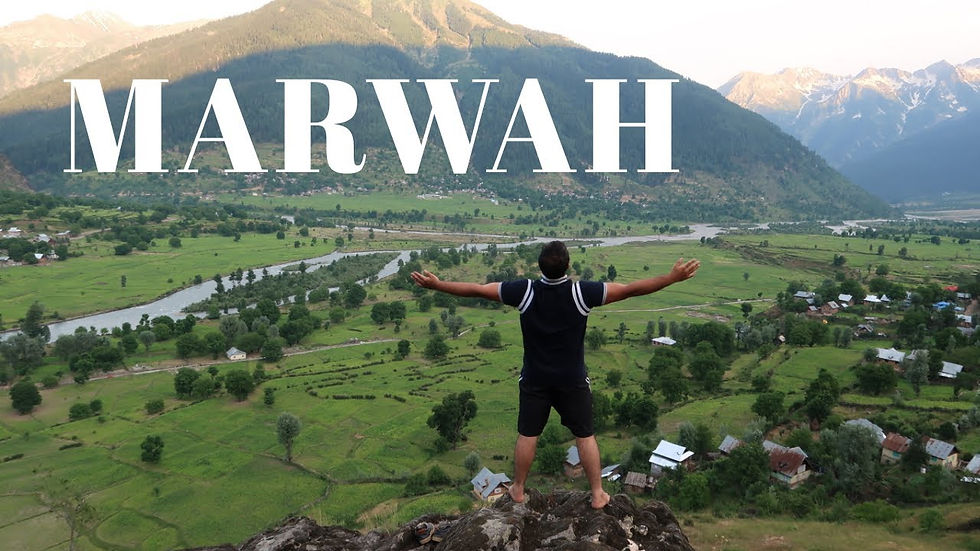
Combine Warwan with Marwah Valley — Two Remote Valleys, One Journey
Marwah Valley lies approximately 25 kilometres from Warwan, connected by a road that follows the Marusudar River through terrain that most travelers to Kashmir never see.
The two valleys are distinct in character. Warwan is elongated — a long corridor between mountain walls, with the river threading through the settlements along its length.
Marwah is a bowl: enclosed, quiet in a way that enclosed landscapes tend to be, the kind of geography that makes you feel looked after rather than exposed. The drive between them is itself a reason to make the connection — the Marusudar in this stretch is one of the most beautiful river corridors in the Himalayas, narrow and fast and coloured a green that does not appear elsewhere.
The combination of Warwan and Marwah in a single journey is the most complete version of what this part of Kashmir has to offer. Plan for a minimum of four to five days in the valley to do both without rushing either.
→ See our full [MARWAH VALLEY GUIDE] for the detailed road, what to see, and how to combine both valleys into a single itinerary.
Warwan + Marwah at a glance • Distance between valleys: ~25 km along the Marusudar River • Recommended combined duration: 4–5 days minimum • Combined vehicle route: Srinagar → Margan Top → Warwan → Marusudar corridor → Marwah → return • Two of Kashmir's most remote and least-visited valleys accessible in a single journey |
Frequently Asked Questions
How far is Warwan Valley from Srinagar?
Warwan Valley is approximately 150 km from Srinagar by road. The drive takes 5 to 6 hours depending on road conditions, the pace at which you travel the mountain sections above Navkan, and how long you stop at Margan Top.
Is Warwan Valley open for tourists?
Yes
Is Warwan Valley safe for a self-drive trip?
The route is manageable for experienced drivers in a capable SUV. The section between Navkan and Margan Top requires genuine mountain driving competence and should not be attempted after dark or in uncertain weather.
If you have not driven high-altitude mountain roads before, travelling with a local driver is the right decision rather than a precaution.
How many days should I spend in Warwan Valley?
A minimum of two full days in the valley is needed to see it properly. Three to four days allows for a more immersive experience — walking between villages, spending time by the river, and getting a sense of the valley's daily life. If you are combining Warwan with Marwah, plan for four to five days total.
Can Warwan and Marwah Valley be visited together?
Yes — and this is the recommended approach. Marwah lies approximately 25 km from Warwan along the Marusudar River, and the drive between them is one of the finest in this part of Kashmir. A combined itinerary of four to five days covers both valleys without rushing either. Tribesmen arranges combined Warwan-Marwah expeditions as a single journey from Srinagar.
The Journey Is the Point
Most travel writing about remote destinations focuses on the arrival. What the place looks like, what you do when you get there, what you bring back.
The road to Warwan Valley earns its own attention before any of that. The seven stages from Srinagar — the steady transition from the populated valley floor, through pine forest and mountain road and high pass, into the Warwan drainage below — constitute one of the most complete mountain journeys available in the Indian Himalayas.
By the time you arrive, you have already seen four distinct ecosystems, crossed a pass at nearly 4,000 metres, and spent several hours in the kind of landscape that recalibrates whatever scale you arrived with.
That is before the valley itself — the river, the villages, the quality of the silence at altitude, the food prepared in a home by someone who has lived here through every season.
Warwan does not ask much of you. A capable vehicle, an early start from Srinagar, and the willingness to let the road take its own time. Everything else it provides.
Plan Your Warwan Valley Trip with Tribesmen We run small-group and private expeditions into Warwan and Marwah Valley. Transport, local guides, and accommodation — arranged from Srinagar. WhatsApp / Call: +91 600 6464 123 support@tribesmen.org | www.tribesmen.org Kashmir-based · J&K Tourism Licensed · Warwan specialists since 2018 |


Comments